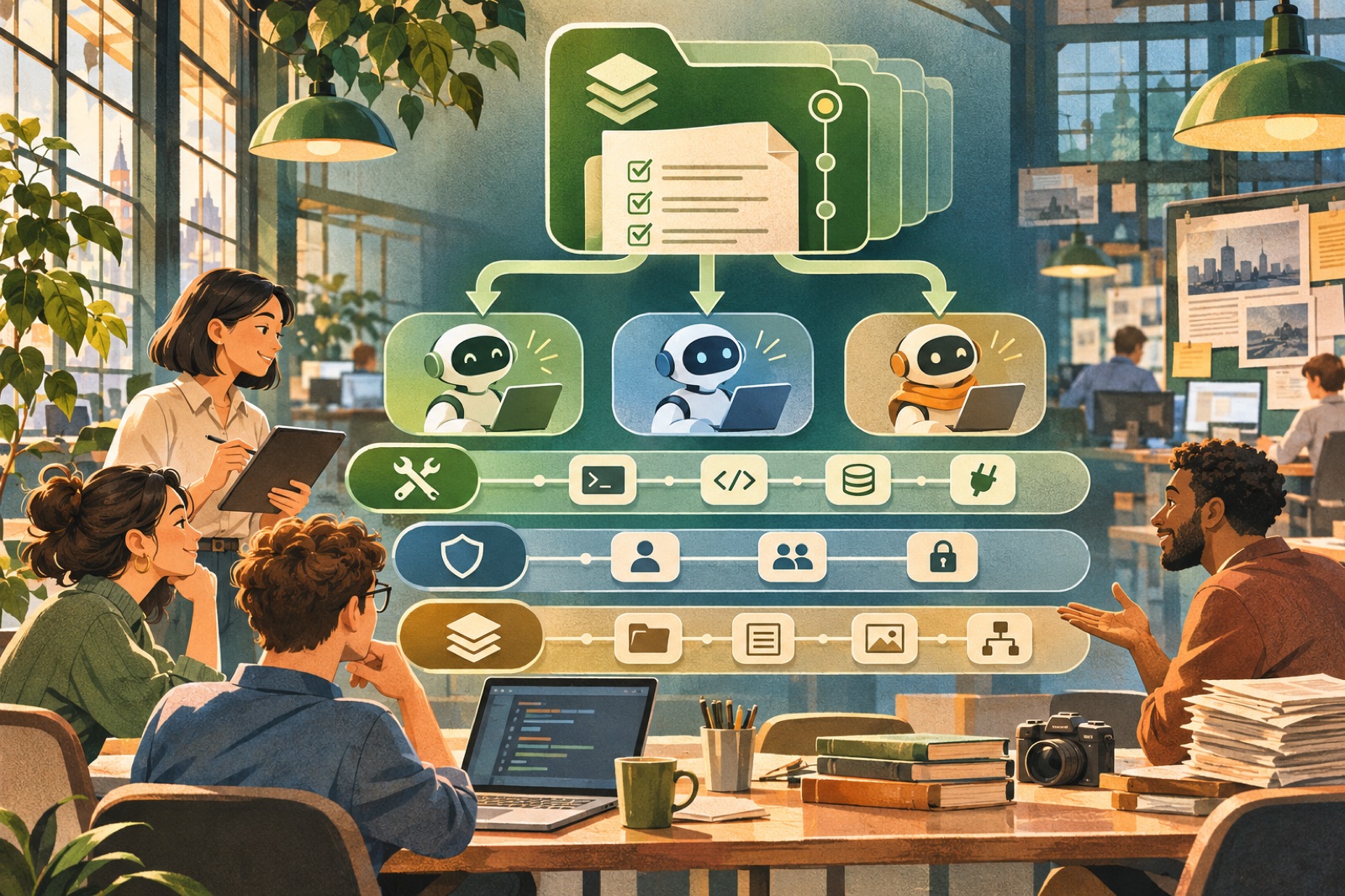
Teams keep explaining the same work to agents: how to review a pull request, prepare a release, or check a customer export. The explanation lives in a chat, gets copied into another prompt, and slowly diverges. A repeatable workflow needs a file that can be versioned, reviewed, and carried to the next agent.
GitHub's practical guide centers that file on SKILL.md inside a versioned skill directory. The directory can hold instructions and supporting resources, giving an agent a reusable description of how a job should be done rather than a one-off request for what to do right now.
Portable instructions, local execution
The important limit is that a skill does not transport the whole runtime. The host still decides which tools are available, what project context is mounted, which credentials can be used, and whether an action is allowed. A skill can travel between agents while its permissions stay behind.
That separation is useful. It lets a team share the procedure without smuggling secrets or assuming that every agent can publish, deploy, or modify the same systems. It also means a skill needs explicit inputs, outputs, and acceptance checks if a different host is expected to run it reliably.
Share what the agent should do; re-check who the host allows it to do.
Make the contract testable
For builders, start with one recurring workflow. Put the steps, expected artifacts, failure conditions, and review points in a versioned skill; keep credentials and permissions outside it; then run the same skill on two hosts and record where their capabilities differ. Portability becomes real when the gaps are visible, not when the file merely looks portable.
GitHub describes an agent skill as a versioned directory centered on SKILL.md, with reusable instructions and supporting files. The post also notes that tools, project context, credentials, and permissions remain specific to the host agent, so a portable skill is not a universal authorization token.
GitHub Blog · Build once, run on any agent ↗