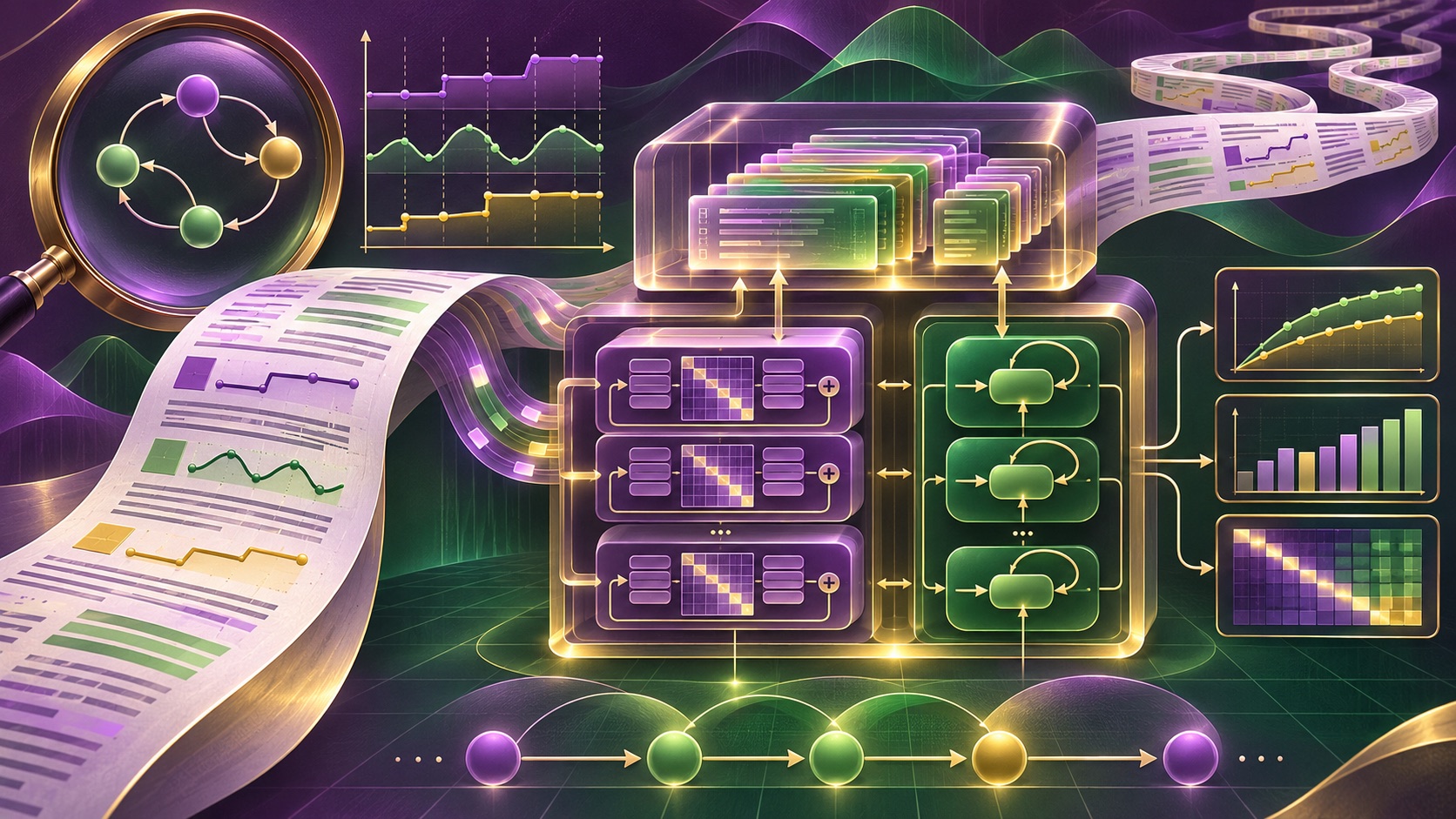
Long context is not the same as reliable memory. An agent can retrieve the latest sentence about a variable and still get the answer wrong if the current value depends on a chain of earlier updates, swaps, or references.
AI2's StateBench is designed to measure that difference. Its four levels move from immutable values to reassignment, self-referential updates, and general finite problems where one variable can take another's current value. The benchmark applies the same underlying structure to code-like sequences, stories, and other formats.
The hard part is carrying state forward
The authors report that tested frontier models performed well on simpler levels but fell sharply on harder problems as the input grew, reaching 13% or lower on the longest general-finite cases. In targeted training experiments, recurrent and hybrid architectures generalized farther than transformers on several tasks, though the benchmark is evidence about this setup rather than a universal verdict on architectures.
An agent that cannot update its internal picture of the world is not remembering; it is searching through old snapshots.
For builders, StateBench suggests testing the transitions in a workflow, not just the final answer. If a customer changes a plan, a file moves, or a task is reassigned halfway through a run, the evaluation should ask whether the agent carried that change through every dependent decision.
AI2 introduces StateBench with four levels of state tracking and reports that tested frontier models degrade on harder dependencies as inputs grow; the benchmark, data, and code are linked from the original post.
AI2 on Hugging Face · StateBench ↗