Robotics research often has the same problem as agent evaluation: a successful demo does not explain what the system learned or why it failed. A controlled world can be less exciting than a household, but it makes the experiment repeatable and the failure traceable.
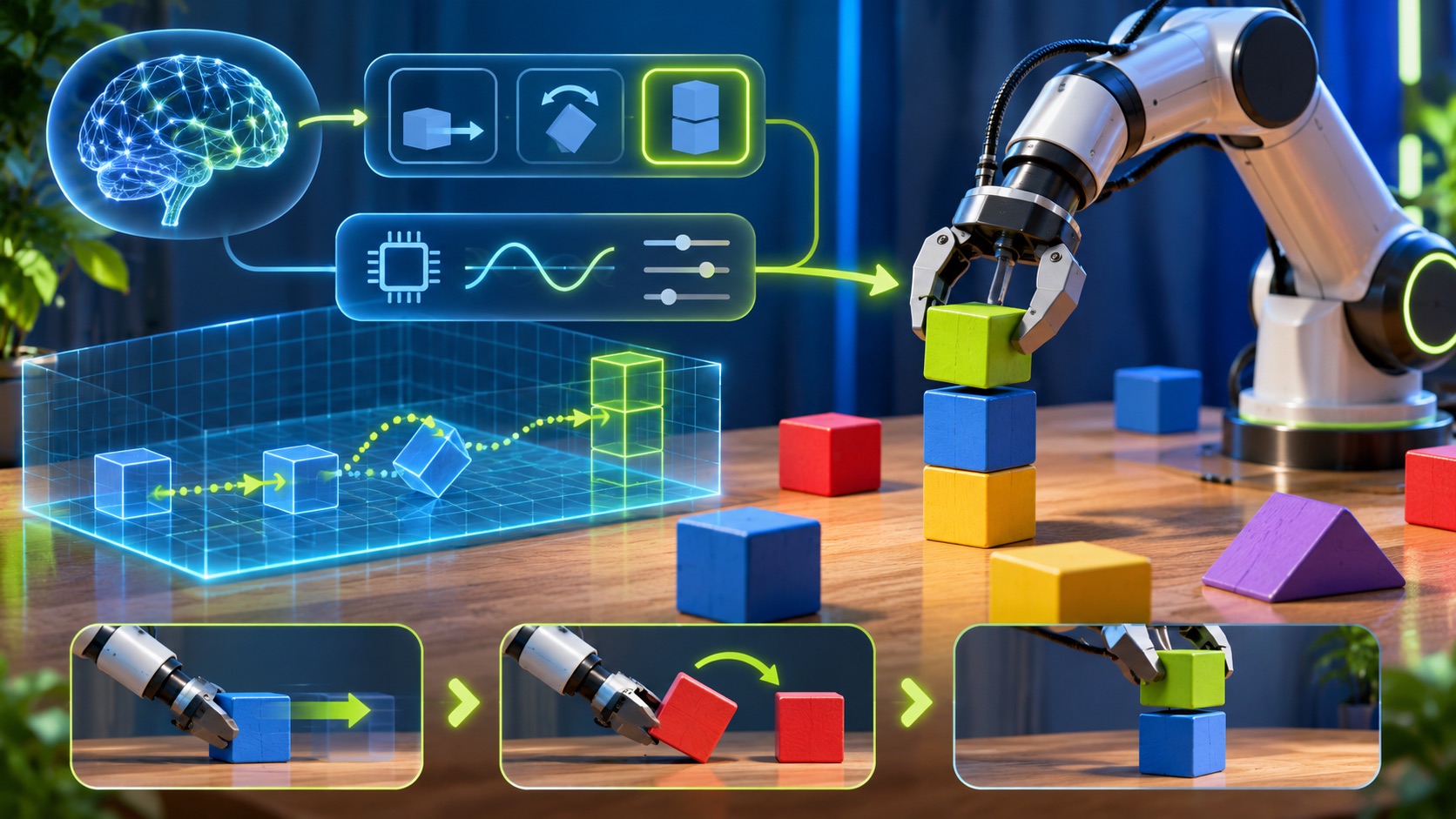
AI2's ToyBlocks is the first example of its FoundationWorlds framework. It pairs a simulated robot arm and tabletop blocks with automatic task and demonstration generation, metrics, code, models, and documentation. The narrow domain is intentional: researchers can vary layouts, skills, and training mixtures without losing control of the conditions.
Reasoning and movement get separate jobs
ToyBlocks uses reinforcement learning and motion planning to generate short-horizon skills such as pushing and flipping, while a task-and-motion planner sequences those skills into demonstrations. A high-level model can choose the skill and the relevant block; a low-level policy controls the simulated arm. AI2 says hundreds of plans can run in parallel on one GPU at up to 24 times real time.
A small world is useful when it lets you change one assumption at a time and still know what the result means.
ToyBlocks is not proof that a robot understands every physical environment. It is a builder tool for asking narrower questions about data, generalization, and transfer to real hardware. That discipline is exactly what makes the next, harder world easier to measure.
AI2 describes ToyBlocks as an open simulation framework and the first FoundationWorld, with code, data, models, and documentation linked from the release; the reported 24x real-time generation rate is from AI2's setup.
AI2 on Hugging Face · ToyBlocks: A controlled world for robot learning and evaluation ↗